News

What machining processes ensure Belt Pulleys groove accuracy and consistency?

2026-10-20 0 Leave me a message

A maintenance engineer installs a new set of Belt Pulleys on a drive system, confident that the specified groove profile and diameter will restore the belt drive to its original performance. Within weeks, the belt begins to squeal, the edges fray, and the belt sits unevenly in the groove. The problem is not the belt. The problem is the groove. The groove angle is off by two degrees, the groove diameter varies along the circumference, and the surface finish is too rough. This scenario is a direct consequence of machining processes that were not capable of holding the required tolerances. For buyers of Belt Pulleys, understanding which machining processes ensure groove accuracy and consistency is essential for avoiding these failures.


This guide is written for procurement engineers and maintenance managers who need to source Belt Pulleys that perform reliably. We will explain the critical groove parameters, the machining processes that achieve them, the inspection methods that verify them, and the criteria for evaluating a supplier. We will also provide detailed product parameters from our factory at Zhejiang Hawen Electromechanical Co., Ltd. Whether you are sourcing pulleys for conveyors, HVAC drives, agricultural machinery, or industrial fans, this guide will help you specify the right machining quality and select a supplier who can deliver it.

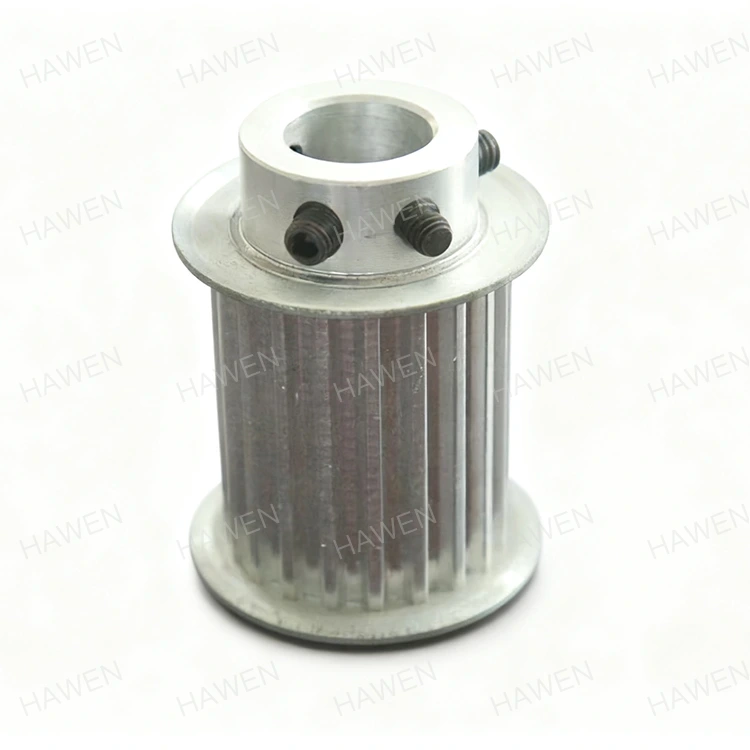
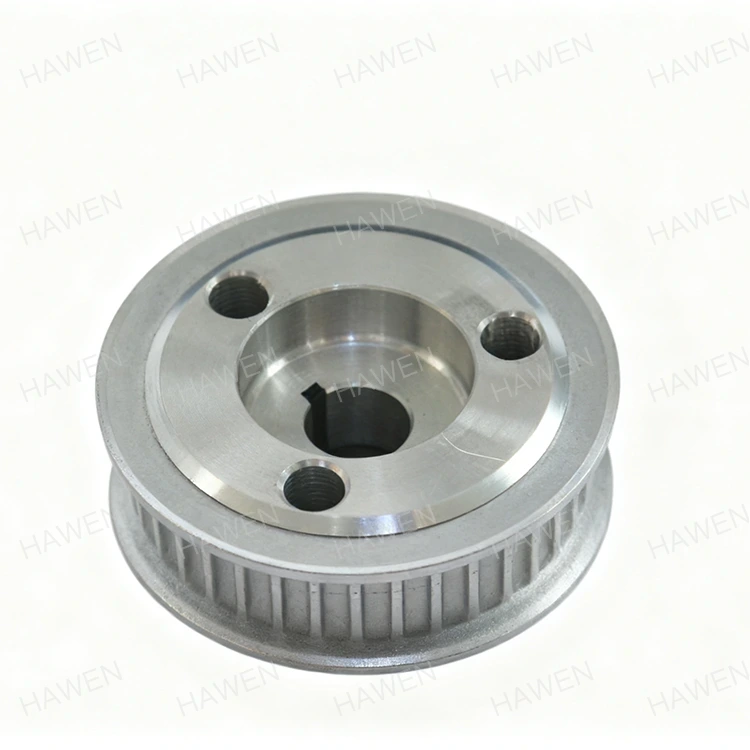
Solid Pulley


Table of Contents


1. What Groove Parameters Determine Belt Pulley Performance?

The performance of a Belt Pulley depends on the accuracy of its groove. The groove is the channel that guides and grips the belt. If the groove is not accurate, the belt will not seat properly, and the drive will lose efficiency, generate noise, and wear prematurely. Four groove parameters are critical: the groove angle, the groove diameter, the groove profile, and the surface finish. The groove angle determines how the belt wedges into the groove. For a V-belt pulley, the standard angle is 34, 36, or 38 degrees, depending on the pulley diameter. An error of just one degree can reduce the belt's power transmission capacity and cause uneven wear. The groove diameter determines the pitch line of the belt, which affects the speed ratio. The groove profile includes the groove depth and the root radius. The surface finish affects friction and belt wear. The table below summarizes these parameters and their typical tolerances.

Parameter Typical Tolerance Impact on Performance
Groove Angle +/- 0.5 degrees Affects belt wedging and power transmission
Groove Diameter +/- 0.05 mm Affects speed ratio and belt tracking
Groove Profile (depth, root radius) +/- 0.1 mm Affects belt seating and wear
Surface Finish (Ra) 0.8 - 1.6 µm Affects friction and belt life
Groove Runout +/- 0.05 mm Affects vibration and belt tracking

At Zhejiang Hawen Electromechanical Co., Ltd., our factory manufactures Belt Pulleys to these tolerances and tighter. We understand that groove accuracy is the foundation of belt drive performance, and we have invested in the machining and inspection equipment necessary to achieve it. Our engineering team can advise on the appropriate tolerances for your specific application.


2. Which Machining Processes Form the Groove Profile?

The groove profile of a Belt Pulley is formed through a sequence of machining processes. The first process is turning, which establishes the basic geometry of the pulley, including the outside diameter, the bore, and the face width. The groove is then cut into the face of the pulley. For V-belt pulleys, the groove is typically cut using a form tool or a CNC grooving tool that matches the required angle and profile. The accuracy of the groove depends on the rigidity of the machine, the sharpness of the tool, and the precision of the tool path. After grooving, the pulley may be ground to improve the surface finish and the dimensional accuracy. The table below summarizes the machining processes and their role in groove accuracy.

Process Function Typical Tolerance Achieved Equipment
Turning Forms OD, bore, and face +/- 0.05 mm CNC lathe
Grooving Cuts the groove profile +/- 0.1 mm, +/- 0.5 degrees CNC lathe with grooving tool
Grinding Improves finish and accuracy +/- 0.02 mm, Ra 0.8 µm Cylindrical grinder
Deburring Removes sharp edges N/A Manual or automated
Balancing Corrects mass distribution G16 or better Dynamic balancing machine

At our factory, we use CNC lathes with live tooling to turn and groove Belt Pulleys in a single setup. This eliminates the error that can occur when the pulley is re-chucked between operations. We also use precision form tools that are ground to the exact groove profile, ensuring that the groove angle and root radius are consistent from part to part.


3. Why Does Grinding Matter for Groove Accuracy and Finish?

Grinding is the process that takes a good pulley and makes it a precision pulley. While turning and grooving establish the basic geometry, grinding refines the groove angle, the groove diameter, and the surface finish. Grinding is performed using a precision grinding wheel that is dressed to the required groove profile. The pulley is mounted on a precision mandrel and rotated against the grinding wheel. The grinding process removes a small amount of material, typically 0.1 to 0.3 mm, and achieves tolerances that are difficult to reach with turning alone. The surface finish after grinding is typically Ra 0.4 to 0.8 µm, which reduces friction and belt wear. The table below compares the accuracy and finish achieved by turning and grinding.

Process Groove Angle Tolerance Groove Diameter Tolerance Surface Finish (Ra)
Turning Only +/- 0.5 degrees +/- 0.05 mm 1.6 - 3.2 µm
Turning + Grinding +/- 0.1 degrees +/- 0.01 mm 0.4 - 0.8 µm

At Hawen, our factory uses CNC cylindrical grinders with in-process gauging to grind the grooves of our Belt Pulleys. The in-process gauging system continuously measures the groove diameter during grinding and automatically compensates for wheel wear. This ensures that every pulley meets the specified tolerance, regardless of the number of parts in the production run. We also dress the grinding wheel at regular intervals to maintain the groove profile and prevent burning or surface damage.


4. How Is Groove Accuracy Verified During Production?

Verifying groove accuracy during production is essential for ensuring that every Belt Pulley meets the specification. The verification process includes in-process inspection and final inspection. In-process inspection is performed by the machine operator using hand tools such as groove gauges, micrometers, and dial indicators. The operator checks the groove angle, groove diameter, and groove runout at regular intervals during the production run. If a deviation is detected, the machine is adjusted before more parts are produced. Final inspection is performed by the quality control department using more precise equipment, such as a coordinate measuring machine (CMM) or a profile projector. The CMM can measure the groove angle, the groove profile, and the groove runout with high accuracy. The table below summarizes the inspection methods and their applications.

Inspection Method What It Measures Accuracy When Used
Groove Gauge Groove angle and profile +/- 0.5 degrees In-process
Micrometer Groove diameter +/- 0.01 mm In-process
Dial Indicator Groove runout +/- 0.01 mm In-process
Profile Projector Groove profile +/- 0.005 mm Final inspection
Coordinate Measuring Machine (CMM) All groove parameters +/- 0.002 mm Final inspection

At our factory, we use a combination of in-process and final inspection to verify the groove accuracy of our Belt Pulleys. Our operators are trained to use groove gauges and micrometers to check the groove angle and diameter every 10 parts. Our quality control department uses a CMM to verify the groove profile and runout on a sampling basis. We maintain detailed inspection records for every production lot, providing full traceability for our customers.


5. How Do You Evaluate a Belt Pulley Supplier for Machining Quality?

Evaluating a Belt Pulley supplier for machining quality requires a focus on equipment, tooling, process control, inspection, and experience. The supplier must have the equipment to turn, groove, and grind pulleys to the required tolerances. This includes CNC lathes, CNC grinders, and precision tooling. The supplier must have a process control system that ensures consistent quality from part to part. This includes tool management, coolant management, and machine maintenance. The supplier must have an inspection system that verifies groove accuracy on every production lot. This includes calibrated gauges, a CMM, and trained inspectors. And the supplier must have experience in producing Belt Pulleys for similar applications. The table below summarizes these evaluation criteria.

Evaluation Criterion What to Look For Why It Matters
Machining Equipment CNC lathes, CNC grinders, live tooling Ensures capability to hold tolerances
Tooling Precision form tools, dressed grinding wheels Ensures groove profile accuracy
Process Control Tool management, coolant management, maintenance Ensures consistency from part to part
Inspection System Calibrated gauges, CMM, trained inspectors Verifies groove accuracy on every lot
Experience Track record in similar applications Demonstrates capability and reliability

At Hawen, our factory has been producing Belt Pulleys for over a decade. We have invested in advanced CNC machining and grinding equipment, and we maintain a comprehensive quality control system. Our engineering team is available to assist with specification and application engineering. We invite you to evaluate us against these criteria and to consider us as your partner for Belt Pulleys.


6. What Are the Key Product Parameters from Our Factory?

The following table provides the key product parameters for our Belt Pulleys. These pulleys are designed for conveyors, HVAC drives, agricultural machinery, and industrial fans. Our factory can also produce custom pulleys to meet specific requirements.

Parameter Specification Range Notes
Outside Diameter 50 - 1,200 mm Custom sizes available
Groove Profile V-belt, timing belt, flat belt Custom profiles available
Number of Grooves 1 - 12 Custom configurations available
Groove Angle Tolerance +/- 0.5 degrees (turned), +/- 0.1 degrees (ground) Selected based on application
Groove Diameter Tolerance +/- 0.05 mm (turned), +/- 0.01 mm (ground) Selected based on application
Surface Finish Ra 0.8 - 1.6 µm (ground) Reduces belt wear
Material Cast Iron, Steel, Aluminum Selected for strength and weight
Balancing G16 or better Reduces vibration
MOQ 10 pieces Negotiable for large orders
Lead Time 2 - 4 weeks Depends on quantity and customization

At our factory, we manufacture our Belt Pulleys to meet these specifications and more. We can customize the diameter, groove profile, number of grooves, material, and tolerances to suit your specific requirements. Our quality control system includes inspection of raw materials, in-process inspection, and final inspection before shipment. Our goal is to provide our customers with high-quality Belt Pulleys that meet their performance requirements.


7. Frequently Asked Questions (FAQ)

Question 1: What is the most critical groove parameter for belt pulley performance?

Answer: The most critical groove parameter is the groove angle. The groove angle determines how the belt wedges into the groove and how much power the drive can transmit. An error of just one degree can reduce the belt's power transmission capacity and cause uneven wear. For this reason, the groove angle should be specified with a tolerance of +/- 0.5 degrees or tighter, depending on the application.

Question 2: Why is grinding necessary if the pulley is already turned?

Answer: Grinding is necessary to achieve the highest level of groove accuracy and surface finish. Turning can achieve a groove angle tolerance of +/- 0.5 degrees and a surface finish of Ra 1.6-3.2 µm. Grinding can achieve a groove angle tolerance of +/- 0.1 degrees and a surface finish of Ra 0.4-0.8 µm. The improved accuracy and finish reduce belt wear, vibration, and noise, and they improve power transmission efficiency.

Question 3: How do I verify the groove accuracy of a pulley I have received?

Answer: You can verify groove accuracy using a groove gauge, a micrometer, and a dial indicator. The groove gauge checks the groove angle and profile. The micrometer checks the groove diameter. The dial indicator checks the groove runout. For critical applications, you can send a sample to a metrology lab for CMM inspection. At Zhejiang Hawen Electromechanical Co., Ltd., we provide inspection reports with every shipment.

Question 4: Can worn pulleys be re-machined to restore groove accuracy?

Answer: In some cases, worn pulleys can be re-machined to restore groove accuracy. The process involves removing a small amount of material from the groove to restore the correct angle and profile. However, this reduces the groove diameter, which may affect the speed ratio. Re-machining is only feasible if the pulley has enough material and if the reduced diameter is acceptable for the application. Our engineering team can advise on whether re-machining is a viable option.

Question 5: What is the typical lead time for custom belt pulleys?

Answer: The typical lead time for custom Belt Pulleys is 2 to 4 weeks after drawing approval. The lead time depends on the complexity of the groove profile, the material, and the quantity ordered. For large orders or complex profiles, the lead time may be longer. At our factory, we work closely with our customers to meet their delivery requirements.


8. Conclusion

Groove accuracy and consistency are the foundation of Belt Pulley performance. The machining processes used to form the groove—turning, grooving, and grinding—determine whether the pulley will deliver reliable power transmission or cause belt wear, noise, and vibration. For buyers, understanding these processes is essential for specifying the right level of quality and for evaluating a supplier. At Zhejiang Hawen Electromechanical Co., Ltd., our factory has the equipment, the tooling, and the experience to produce Belt Pulleys that meet the most demanding groove tolerances. We use CNC machining and precision grinding to achieve groove angle tolerances of +/- 0.1 degrees and surface finishes of Ra 0.8 µm or better.

Whether you are sourcing pulleys for conveyors, HVAC drives, agricultural machinery, or industrial fans, we invite you to contact us to discuss your requirements. We can provide samples, technical data, and customized solutions. Our commitment to quality and customer satisfaction has made us a trusted partner for businesses around the world.

Contact Zhejiang Hawen Electromechanical Co., Ltd. today to discuss your Belt Pulley requirements and discover how our machining capabilities can meet your groove accuracy specifications.

Related News
Leave me a message
X
We use cookies to offer you a better browsing experience, analyze site traffic and personalize content. By using this site, you agree to our use of cookies. Privacy Policy
RejectAccept